
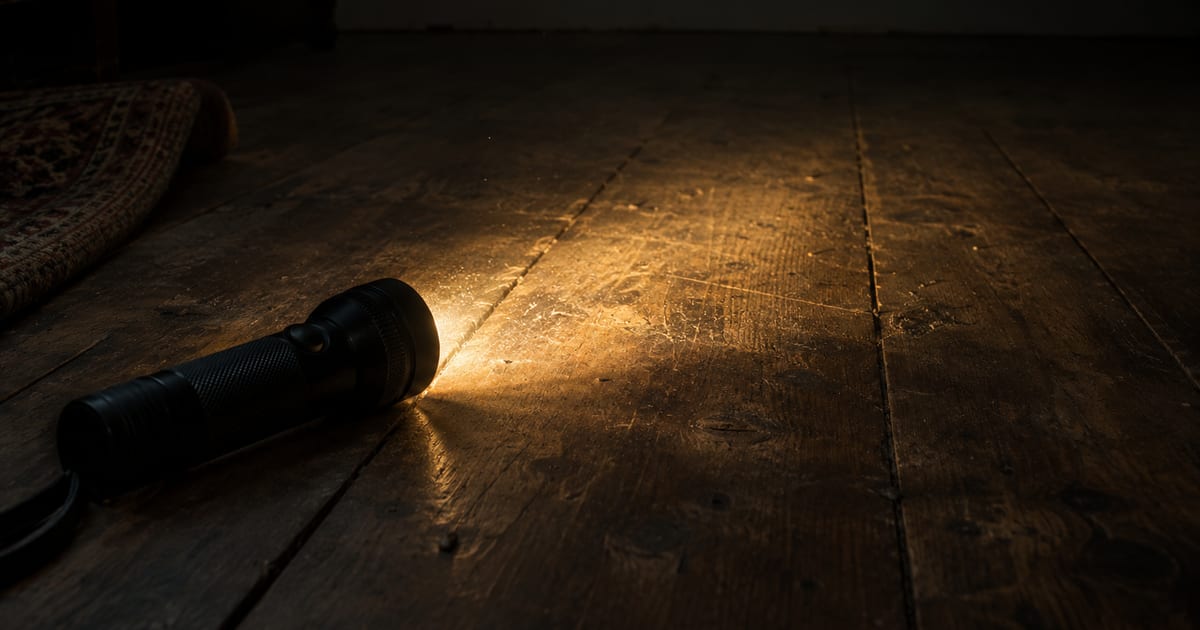
Search the room in lanes, like mowing a lawn, and never cross ground you have already cleared. Slim stays where he is. Patapim does not, so old ground is the most dangerous part of the room. That one habit saves more battery and more levels than anything else on this page.
Everything here comes from the way the game is actually built, not from a feeling about it. Three things are true in every room: the beam is a circle, Slim is stationary and only visible inside that circle, and Brr Brr Patapim moves to a new spot every few seconds. Almost all good play follows from those three facts.
Why does sweeping in lanes beat waving the light around?
Because the beam is small and the room is not. When you move the light in loops, you cover the middle of the room three or four times and the edges never at all, and the clock and the battery are both paying for those repeats.
Treat the room like a lawn. Start in one corner, run the beam straight across to the other side, drop down by a little less than the width of the beam, and run it back. Keep the overlap small but real, so no thin strip gets skipped between passes. Done properly, you cover the whole room exactly once. That is the cheapest possible search, and it is the only way to be certain that you have actually looked everywhere rather than looked hard at the middle.
Why is doubling back the move that gets you caught?
Because the two things in the room behave differently. Slim does not move, so a strip you have cleared stays clear of Slim forever. Patapim does move, so a strip you cleared ten seconds ago tells you nothing about where he is now. He could have walked into it while you were three lanes further on.
That asymmetry is the whole game. Every time you swing the light back over old ground, you are searching a place Slim is provably not, in a place Patapim may well now be. It is the worst trade available and it is the one almost everybody makes.
Trust the lane. If you sweep a strip and Slim is not there, he is not there.
What do you lose by clipping the corners?
The corners of the room get the least light, because a circle does not fit into a right angle. If you turn the beam early at the end of a lane, you leave a crescent of floor at each wall that has never been lit, and Slim fits comfortably in one.
Run each lane a little past where it feels finished, so the full circle passes over the corner before you turn. It costs a fraction of a second per lane, and it is the difference between a search you can believe and a search you will end up repeating.
Should you hurry, or go slowly?
Both cost you something, which is the actual puzzle. The clock punishes a slow, careful sweep. The battery punishes a fast, sloppy one, because sloppy means a second pass, and a second pass is a whole extra search on a battery already half spent. Which of the two gives out first depends on how you play, and the clock or the battery works through both cases.
The resolution is not speed, it is one steady pace. Pick a speed at which you can hold a straight line and keep your overlap honest, and use the same one in every room. A single complete sweep at a medium pace beats a frantic sweep followed by a panicked one, every time. If the level ends with time to spare and battery left over, you can afford to go slightly faster next room. If it ends with the room dark, you were never moving too slowly, you were repeating yourself.
Does it help to decide your route before the room starts?
Yes, and it is free. The decision of where to start and which way to travel takes a second or two if you make it after the room has already begun, and those seconds come out of the clock while the light is on.
Pick one route and keep it. Top left corner, across to the right, down a lane, back to the left. Always the same. A route you do not have to think about is a route you can run while paying attention to the screen rather than to your own plan, and the habit carries into rooms where you have less margin.
What actually changes in the later rooms?
The rules do not change. The listing describes dynamic difficulty, with the levels getting harder as Brr Brr Patapim becomes more aggressive, and that is what you feel through the map: the same room, the same beam, the same frog, with less room for a wasted pass. The map runs to twenty five named levels, from The Whispering Woods and the Haunted House through Slim’s Lair and Patapim’s Parlor, and on to The Croaking Well and Final Ascent.
So the later rooms are not a new skill. They are the early rooms with the slack taken out. Whatever habits you built in The Whispering Woods are what you will be running in Final Ascent, which is a good argument for building them deliberately in the easy rooms instead of learning them under pressure. The how to play guide covers the same method from the beginning if you want to practice it from room one.
What does Premium actually change?
It changes two of the three things that can end a level and neither of the other two parts of the game. According to the listing, the Premium upgrade gives unlimited battery, removes the adverts and gives instant level access, which in practice means no waiting for the battery to recharge or after a lost attempt. It does not skip you ahead on the map. The clock still runs. Patapim still moves, and your beam landing on him still ends the room.
Read that as what it is. Removing the battery does not make the game easy, it removes one of the two clocks, and the harder one for most players is the one on screen. It is worth knowing before anyone decides the upgrade is a shortcut through the later rooms, and worth knowing if a parent is weighing up the purchase at all, which the parents’ guide covers alongside the adverts and the age rating.
One practical note: Premium is a non consumable in app purchase, so if the game is reinstalled or the phone is replaced, you should not have to buy it twice. Apple’s guidance is to open the app, look for a restore option in its store, main menu or settings, and make sure you are signed in with the same Apple Account used for the original purchase.
What still comes down to luck?
Where Slim is. The positions are set when the room begins, so a good method is a way of finding him in less time and less battery than a bad one, not a way of knowing where he already is. Some rooms will hand him to you in the first lane and some will hide him in the last corner you reach, and no habit changes that.
What a method does change is the number of rooms you lose to a repeated search or a nervous swing of the light back across ground you already cleared. That is most of them.
If you want to try the lane method on something with no clock attached, the first room is free and takes about two minutes. Run one clean sweep, corner to corner, and see how much of the room you actually cover the first time.
Before you go further, the honest parent facing version of this game is written up separately in how scary Brr Brr Patapim Game really is, which is worth reading if you are the one about to hand the phone over.